The Morning Checklist Myth: More Steps Do Not Mean More Clarity
A morning checklist works better when it groups decisions by moment, helping you spot what matters now without scanning a crowded list.
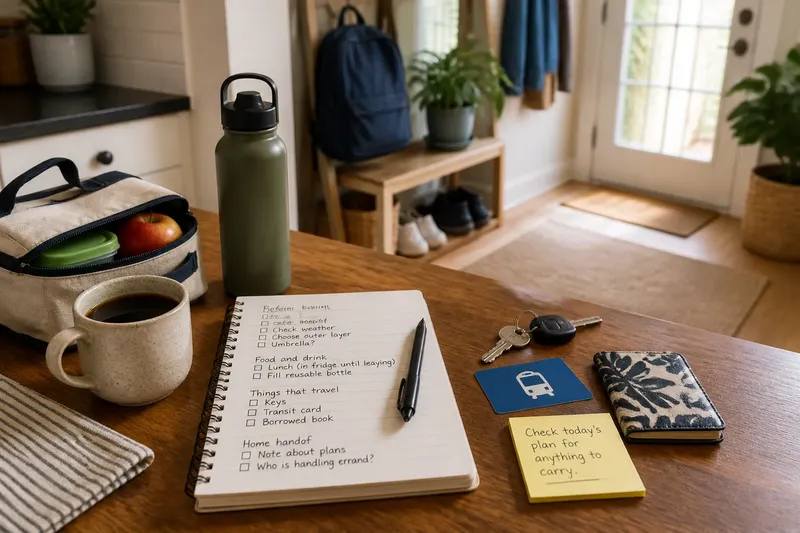
Your morning checklist says “make coffee,” “pack lunch,” “find keys,” and “check the weather,” yet you still stand in the kitchen wondering what to do next. A morning checklist should reduce decisions, not preserve every tiny action in writing. Its clarity depends on how tasks are grouped, when you need to see them, and whether each line points to a useful choice.
A longer list can look reassuring because nothing seems forgotten. But when every action gets its own line, the page becomes another thing to process before the day begins. Grouping related decisions can make a shorter list easier to use without pretending every household follows the same morning rhythm.
What should a morning checklist help you decide?
Start with the list’s job. Is it there to help someone leave the house, make sure a child has what they need, or keep a work-from-home morning from dissolving into small distractions? One list can serve more than one purpose, but its main purpose should be obvious.
Separate actions from decisions. “Put on shoes” is an action that may happen without a reminder. “Take an umbrella?” is a decision that depends on the weather. A checklist earns its space when it prompts a choice you might otherwise overlook or gathers actions under a heading that helps you move through them.
That distinction also makes pruning easier. If a line describes something you reliably do as part of another task, it may not need to stand alone. If forgetting it would cause a real snag, keep it visible or group it with the moment when it matters.
Why can tiny steps make the list harder to scan?
Each extra line asks for attention. A page that lists “open the refrigerator,” “take out the milk,” “pour coffee,” and “put the milk away” may be thorough, but it gives routine motions the same visual weight as remembering a lunch container or carrying a library book.
That can hide the decisions that genuinely need prompting. The eye has to pass familiar instructions before reaching an item that depends on what is happening today. A crowded list also makes it harder to notice whether another line already covers a task.
Not every detail is needless. Someone learning a new routine, sharing care tasks, or adjusting to a disrupted schedule may benefit from explicit prompts for a while. The useful question is whether a detail helps the intended reader act, not whether the list looks impressively complete.
How can you group a morning checklist?
Group tasks by the moment or decision that connects them. These headings can be more useful than a long string of actions because they help the reader find the right part of the routine quickly.
- Before leaving: Check the day’s weather, choose an outer layer, and decide whether an umbrella is needed.
- Food and drink: Pack breakfast or lunch, fill a reusable bottle, and put refrigerated items in the bag near departure.
- Things that travel: Gather keys, a transit card, a work badge, or the item needed for an appointment.
- Home handoff: Tell another person about a change in plans, leave a note, or confirm who is handling a shared errand.
These groups are starting points, not a universal template. In one home, a packed bag sits by the door. In another, food must stay in the refrigerator until the last moment. Keep each heading tied to the actual setting, and avoid making a group so broad that it becomes a second, unexplained checklist.
Should you group tasks by time or place?
Choose the organizing cue that matches how you move. A time-based list might have “before breakfast” and “before leaving.” A place-based one might use “kitchen,” “entryway,” and “desk.” The first helps when timing is the main source of confusion; the second helps when items and tasks are scattered around a shared space.
There is no need to combine both systems unless the routine calls for it. Too many layers of headings can make a short list feel like a filing cabinet. If you often return to the kitchen to retrieve something, a place cue may help. If an item must be packed only after breakfast, a time cue may be clearer.
Say you share an apartment and usually leave with a transit card, lunch, and a borrowed book to return. Imagine grouping the list under “Before leaving” and putting those three checks together, with “lunch” marked as the item that stays in the refrigerator until departure. The expected observable result is that you can scan for the relevant items at the right moment instead of searching through scattered lines.
What should you do with tasks that change each day?
Keep stable habits on the main list and give changing details a small, visible place beside them. A routine may always include checking the calendar, while the calendar determines whether you need a laptop, a signed form, or no extra item at all.
A prompt such as “check today’s plan for anything to carry” can work better than listing every possible document. It tells the reader where the decision comes from without turning the checklist into a catalog of hypothetical errands. If several people use the list, name the source clearly: a shared calendar, a note on the counter, or a message from a caregiver.
What is not worth the effort? Recording every possible variation in advance. A long menu of rare situations can make the ordinary morning harder to read. Add a new line when a recurring need becomes easy to miss, not simply because it could happen someday.
How can you tell whether a shorter list is clearer?
Look at what happens during the routine. Does someone pause because the list is vague? Do two lines prompt the same action? Is an important item buried among reminders that no longer help? Those observations point to a specific edit, unlike the vague goal of making the list shorter.
Try one change at a time. Merge related lines under a clear heading, then notice whether the intended reader can find the next useful decision. If a heading causes confusion, make it more concrete or split the group. The list should reflect the household’s actual language; “work things” may mean very different objects to different people.
Also consider where the list lives. A note by the entryway can help with departure checks, while a phone reminder may suit someone who starts the morning in several places. Choose a medium that keeps the list easy to see when needed, rather than one that forces someone to search for it.
What do people ask about morning checklists?
How many items should a morning checklist have?
There is no ideal count for every routine. Keep the items that prompt meaningful decisions or prevent recurring omissions, then group actions that naturally happen together.
Should a morning checklist include ordinary habits?
Include a habit if its reminder helps the person using the list. If it happens automatically and never causes a problem, a separate line may add clutter rather than clarity.
Is a paper or phone checklist easier to use?
Choose the format that is visible where the decision happens. Paper may suit a shared kitchen or entryway, while a phone can work well for a routine that changes with the day’s calendar.
When should you revise a morning checklist?
Revise it when the household’s schedule changes, when a line repeatedly causes confusion, or when a new recurring task becomes easy to miss. A brief review after a change is more useful than constant tinkering.
How can a checklist stay useful as routines shift?
Treat the list as a small shared tool, not a record of every ideal morning. When work hours, school plans, or household responsibilities change, remove prompts that no longer fit and add only the new decision that needs support. A clear heading can often absorb a changed task without expanding the page.
Read the morning checklist from the perspective of the person who uses it: at what moment do they need the reminder, and what choice should it help them make? That question keeps the list grounded in daily life. A few well-placed groups can make the next action easier to spot, even when the morning itself is anything but tidy.